
How can I find competitor websites through Google search results?
Find competitor websites by searching Google for the keywords and topics your target customers use, then record the domains that repeatedly appear in the organic results. Compare these websites by search intent, target audience and content type to identify genuine SEO competitors and relevant opportunities.
To find competitor websites through Google search results, search the terms your target customers use and record the domains that appear repeatedly in the organic listings. The websites that consistently rank for your commercially important topics are potential SEO competitors, even if they do not offer exactly the same products or services as your business.
Start by creating a list of relevant search queries. Include the main services or products you provide, the problems you solve, and the questions customers ask before making a purchase. Include variations such as location-based searches, comparison queries, service-specific terms and informational questions. For example, a business selling accounting software might examine searches relating to accounting software for small businesses, bookkeeping automation and how to choose accounting software.
Search each query in Google and review the organic results rather than focusing only on advertisements, map listings or other search features. Record the page title, URL and root domain for each relevant result. Looking at the page itself is useful because the ranking URL may be a guide, category page, product page or service page rather than the competitor’s homepage.
Use a consistent search environment when collecting results. Search personalisation, location, language, device and previous browsing activity can affect what appears. Where possible, use a logged-out browser, apply the relevant UK location and keep the device type consistent. Search results also change over time, so treat a single search as an indication rather than definitive evidence.
After collecting the results, group the domains that appear repeatedly. A domain that ranks for several closely related searches is more likely to compete for the same organic visibility than a website that appears for only one broad term. Look for patterns across:
- Core service and product searches
- High-intent searches that indicate a need to buy or enquire
- Problem-based and informational searches
- Location-specific searches relevant to your target market
- Comparison, alternative and review searches
- Longer, specific searches that reflect specialist customer needs
Do not assume that every website appearing in the results is a direct competitor. Google may rank publishers, directories, government sites, educational resources, marketplaces or review websites alongside commercial providers. These sites may compete for attention and clicks, but they are not necessarily competing with your business for customers.
Classify each domain according to the type of competition it represents. A direct SEO competitor targets similar customers with a similar product or service. An indirect competitor serves the same customer need through a different solution. A topical competitor publishes content that ranks for the same questions but may not sell a comparable product. Separating these groups prevents your analysis from treating every visible result as an equivalent business.
Review the search intent behind each query before comparing websites. Search intent describes what the searcher is trying to achieve. A query seeking a definition requires different content from a query showing an intention to compare suppliers or request a service. A competitor may rank strongly for informational topics but have little visibility for valuable commercial searches, or the reverse.
For each relevant competitor domain, compare the pages that rank and note:
- The search terms and topics the page targets
- Whether the content matches the searcher’s likely intent
- The page format, such as a service page, guide, comparison or case study
- How clearly the offer, audience and next step are explained
- Whether the page demonstrates relevant expertise and trust
- The breadth and depth of related content on the domain
- Whether the site appears to serve the same geographical market
Pay particular attention to repeated gaps. If several relevant websites rank with weak explanations, limited evidence or incomplete coverage, this may indicate an opportunity to produce a clearer and more useful page. A competitor’s ranking does not automatically mean its content is the best available; Google evaluates many signals, and rankings can reflect authority, relevance, links, technical accessibility and other factors as well as copy quality.
Use search-result features as additional evidence. Related searches, autocomplete suggestions and question-based result features can reveal variations in how people describe the same need. These suggestions should be checked against your audience, products and service area before being added to your research. They are useful for expanding the query set, but they should not replace judgement about commercial relevance.
Once the initial research is complete, create a competitor map that records each domain, the queries where it appears, the ranking page, the apparent search intent and its competitor category. This makes it easier to distinguish consistently visible domains from occasional results and gives you a reliable basis for content gap analysis, keyword prioritisation and ongoing monitoring.
Refresh the review periodically and compare changes rather than relying on a single snapshot. New websites may begin ranking, established domains may expand into related topics, and Google may change the result types shown for a query. Combine these findings with checks of the website’s audience, offer and business model to verify whether a domain is a genuine SEO competitor. Search-result visibility identifies who competes for attention; further validation determines who competes with your business.
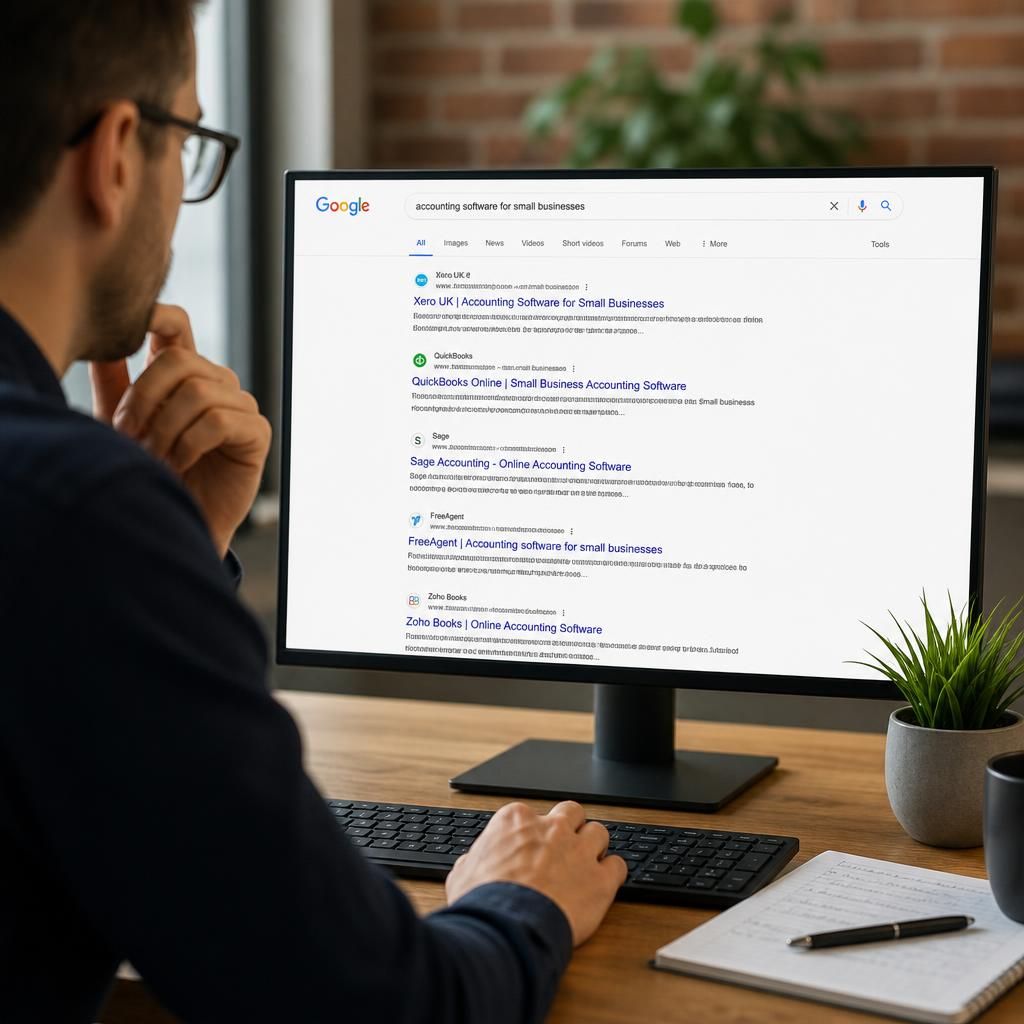
Google search results reveal potential SEO competitors by showing which websites repeatedly attract visibility for the searches that matter to your audience. The most useful results are not necessarily businesses offering the same product; they are websites competing for attention, clicks and visibility around the same customer need.
Review each result in context rather than recording domains alone. Note the search query, ranking page, content format and likely search intent. A service page ranking for a supplier-focused query represents a different type of competitor from an advice article, directory listing or review page ranking for an informational search.
- Direct competitors: businesses targeting similar customers with a comparable product or service.
- Indirect competitors: businesses addressing the same problem through a different solution.
- Topical competitors: publishers, directories or other sites competing for visibility on relevant questions without offering an equivalent service.
Group domains that appear across several relevant searches, then compare the pages that rank. This helps distinguish consistent competitors from sites that appear because of one broad or loosely related query. Validate the strongest candidates by checking their audience, offer, geographical focus and commercial intent before using them in competitor or content-gap analysis.
Start Finding Competitor Websites Through Google Search
Start finding competitor websites by reviewing the Google results for your priority customer searches, then record recurring domains, ranking pages and search intent in your competitor research. Use these findings to validate genuine SEO competitors and identify content opportunities for your next campaign.