
Can a keyword rank tracking tool track local search rankings?
Yes. A keyword rank tracking tool can monitor local organic rankings and, where supported, map pack positions for specified locations, devices and search terms, giving you a clearer view of how your business appears to nearby searchers.
Yes. A keyword rank tracking tool can monitor local organic rankings and, where supported, map pack positions for selected search terms, locations and devices. This shows how visible a website or business profile is to searchers in a defined area, rather than relying on a single national ranking that may not reflect local performance.
Local rank tracking usually covers two distinct types of visibility:
- Local organic rankings: the position of a website page in the standard search results for a location-specific search.
- Map pack rankings: the position of a business listing among the local results displayed with a map, where the tracking system supports this feature.
These results should be monitored separately. A business may rank well in the organic results but not appear prominently in the map pack, or have a strong map pack presence while its relevant service page performs less well in organic search. Separating the two makes it easier to identify the right optimisation activity.
To produce useful local data, the tracking campaign needs a defined search location. Depending on the tool, this may be a country, region, town, postcode, address or point on a map. More precise locations generally provide a more realistic view of performance for businesses serving a particular area. Tracking the same keyword from different locations can reveal how visibility changes across a town, service area or group of branches.
Device selection is also important. Local results can differ between desktop and mobile, particularly where searches involve maps, directions or nearby services. Tracking both devices, where relevant to the audience, helps distinguish a genuine local trend from a device-specific result.
Local search rankings are affected by more than the wording of a keyword. Search engines may consider the searcher’s location, the business’s relevance to the query, the prominence and accuracy of its business information, and the authority of the business in the local area. As a result, rankings can vary from one street or postcode to another. A local tracking tool does not remove this variation; it measures it by checking results from consistent, specified locations.
For a business with several premises, create separate tracking locations and group keywords by branch or service area. For example, a campaign might separate searches for a core service, service-plus-location terms and searches using local intent such as “near me”. This makes it possible to compare performance by location without combining unrelated results.
Useful local tracking data can include:
- the current and historical position for each keyword and location;
- visibility in the local pack, where available;
- the URL appearing for each organic result;
- changes in rankings after website, content or business profile updates;
- competitor domains or listings appearing for the same local searches;
- locations where rankings are strong, weak or inconsistent; and
- keywords that generate local visibility but are not yet being targeted effectively.
Historical data is particularly valuable because local rankings can fluctuate for reasons that are not directly related to a website change. Comparing several checks over time helps distinguish a temporary movement from a sustained trend. It is also useful to annotate the campaign when making significant changes, such as publishing a location page, correcting business details, improving internal links or updating a business profile.
Rank tracking should be combined with other local SEO evidence. Search Console can help show organic queries, impressions, clicks and landing pages, while business profile reporting can provide information about actions taken from a listing. Analytics and conversion data are needed to establish whether local visibility leads to enquiries, calls, visits or other valuable actions. Rankings indicate exposure; they do not, by themselves, prove that a campaign is generating business.
When reviewing local results, avoid treating one position as an absolute measure of success. Check whether the correct landing page is ranking, whether the result matches the searcher’s intent, and whether visibility is consistent across the locations that matter commercially. A small ranking improvement for a high-value service in a priority area may be more meaningful than a larger movement for a low-value term in a location you do not serve.
Before relying on the results, confirm that the campaign uses the correct keyword variants, search locations, language, country and device settings. Also check whether map pack tracking is available for the locations being monitored and whether the reported result represents a business listing or an organic page. Correct configuration is essential because a national check, an imprecise location or the wrong device can give a misleading impression of local performance.
Used in this way, a keyword rank tracking tool provides a repeatable view of local search visibility. It helps identify coverage gaps, compare locations, assess changes over time and prioritise work on the pages and business listings that influence local discovery.
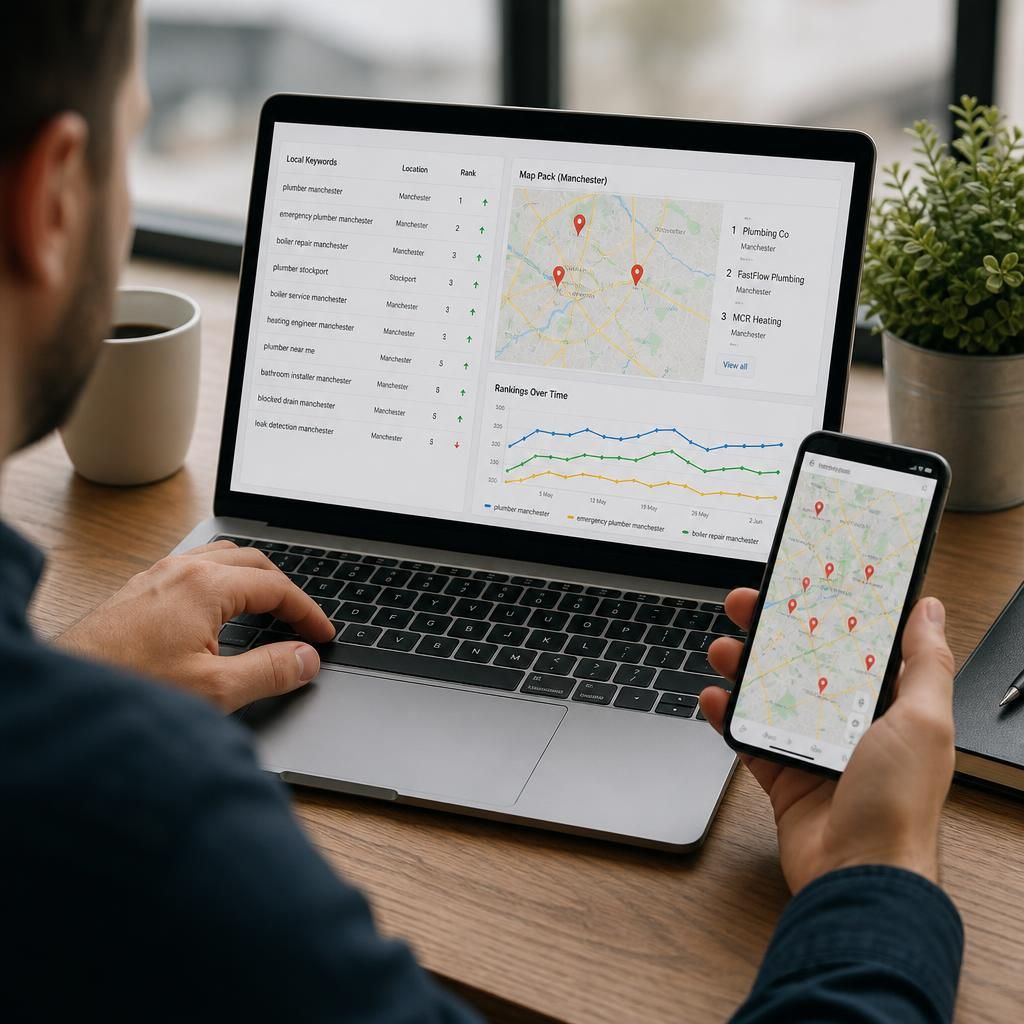
A local keyword rank tracking tool measures search visibility from a defined location, such as a town, postcode, address or map point. This is important because local results can change between nearby areas, so a national ranking may not reflect what customers see in the places a business serves.
For useful comparisons, track the same keywords from consistent locations and separate organic results from map pack positions. Device settings should also match the audience, as local results can differ between mobile and desktop. For businesses with multiple premises, create a location for each branch or service area and review:
- the organic position and ranking URL;
- map pack visibility, where supported;
- changes over time after local SEO updates; and
- competitor listings appearing for the same searches.
This approach shows where local visibility is strong, where it is inconsistent and which location pages or business listings may need attention. Rankings should then be compared with enquiries, calls and other conversion data to assess whether increased visibility is producing valuable actions.