
Can local rank tracking monitor Google Maps visibility?
Yes. Local rank tracking can monitor your visibility in Google Maps and the local map pack by checking how your business appears for selected searches, locations and service areas. It helps you identify changes in local performance and assess whether your Google Business Profile is reaching potential customers.
Local rank tracking can monitor Google Maps visibility by testing how a business listing appears for selected local searches, locations and service areas. It records whether the Google Business Profile is present in Google Maps and the local map pack, where it appears in the results, and how that visibility changes over time. This provides a more realistic view of local search performance than relying solely on organic website rankings.
Google Maps visibility is location-sensitive. A business may appear prominently when someone searches near its premises but be less visible from another part of the same town or service area. Local rank tracking accounts for this by using defined search locations, such as a postcode, town, address or mapped point. Repeating the same searches from consistent locations makes it easier to identify genuine changes rather than results caused by an individual user’s whereabouts.
A tracking campaign can monitor several related search formats, including:
- Business-name searches, which show whether the listing is being returned for navigational searches.
- Service and location searches, such as a service followed by a town or area.
- Generic service searches without a location modifier, where Google uses the searcher’s location to determine local results.
- Google Maps results and the local map pack displayed alongside or above traditional organic listings.
- Searches from different areas within a service region, revealing where visibility is strong, weak or inconsistent.
The main measurement is usually the listing’s position for each tracked keyword and location. A tracker may also show whether the listing was found at all, its local visibility across a group of keywords, and changes in performance over time. Reviewing the complete keyword set is important because a business can maintain a strong position for its brand name while remaining difficult to find for valuable non-brand searches.
Google Maps and the local map pack are closely related but should not be treated as identical. Google Maps is a dedicated map-based search experience, while the local map pack is a local result feature that can appear within standard Google search results. The businesses shown, their order and the amount of information displayed can vary between these environments. A reliable local tracking process therefore monitors the relevant result types separately where the platform supports it.
Tracking results should be interpreted as a consistent benchmark rather than an exact representation of every search. Google can adjust results according to location, device, search history, language, search intent, listing relevance and other contextual signals. Results may also change as businesses open or close, profiles are updated, categories change or the search engine tests different layouts. Using fixed settings and comparable searches helps limit this variation, but no tracking tool can reproduce every user’s individual result.
Google Maps monitoring is particularly useful for identifying patterns that are difficult to see from occasional manual checks. For example, reports may show that visibility is strong near the business address but declines towards the edge of the service area. They may also reveal that a profile performs well for one service but not for another, or that visibility has changed after an update to the business category, service information or landing page.
When a decline is identified, review the factors that support local visibility rather than making changes based on position alone. Check that the Google Business Profile is verified, accurate and complete. Confirm the primary and additional categories, business name, address, phone number, opening hours, services and website URL. Make sure the profile reflects the areas actually served and that the linked landing page provides clear, relevant information for the location and service being tracked.
It is also useful to compare ranking movements with other local signals. These can include changes to profile completeness, review activity, business information across reputable directories, locally relevant website content and the technical accessibility of the linked page. Tracking cannot prove that any single change caused a ranking movement, but it can show whether visibility changed after a material update and help prioritise further investigation.
For the clearest assessment, track a balanced set of important services, locations and search intents, and review trends rather than isolated daily movements. Combine Google Maps visibility data with website traffic, enquiries, calls and other conversion measures where available. Rankings indicate how easily people can find the listing; they do not by themselves show whether visitors contacted the business or became customers.
In practice, local rank tracking gives you a repeatable way to monitor Google Maps presence across the areas that matter to the business. It highlights coverage gaps, separates branded visibility from service-led discovery and provides evidence for improving the profile, website and wider local SEO activity.
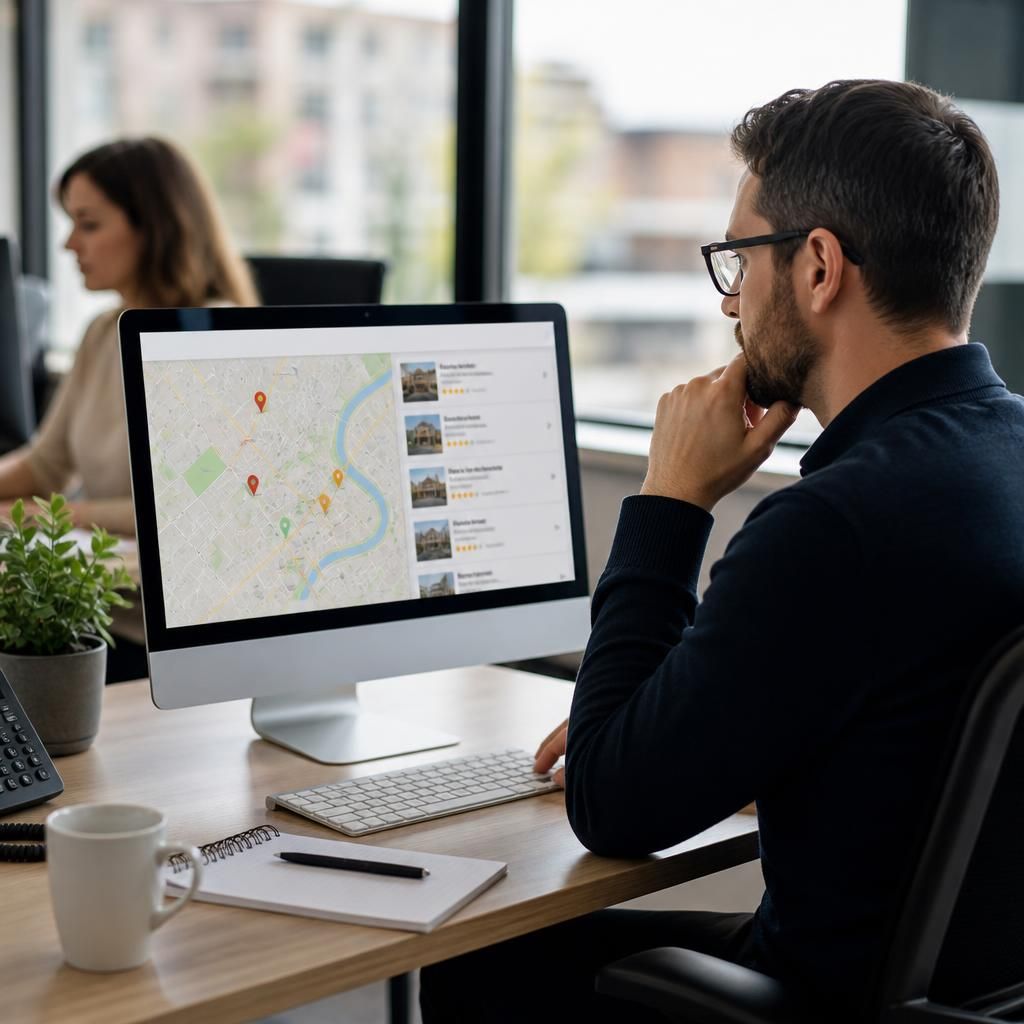
Local rank tracking monitors Google Maps visibility by checking whether a business listing appears for chosen searches from consistent locations. This is important because local results vary across a town or service area: a profile may be prominent near the business address but less visible several miles away.
Tracking the same services, locations and search intents over time shows where visibility is strong and where coverage gaps exist. Review Google Maps and local map pack results separately where possible, as they are related but not identical search environments. Use the findings alongside profile accuracy, reviews, website performance and enquiries to decide which local SEO improvements require attention.
Track your Google Maps visibility
Use your local rank tracking campaign to monitor Google Maps visibility across your priority services and locations, then review the results alongside enquiries and profile updates. Identify coverage gaps and prioritise the local SEO improvements most relevant to your business.