
How does local rank tracking measure search visibility?
Local rank tracking measures search visibility by checking where your website or local listing appears for target keywords when searches are performed from specific locations. It records positions across local organic results and, where configured, map results, showing how rankings vary by search term and location over time.
Local rank tracking measures search visibility by recording where a website or local business listing appears for selected keywords when searches are performed from defined locations. It can monitor local organic results and, where configured, map results, then compare positions across search terms, locations, devices and dates.
The process starts with a defined tracking setup. You select the keywords that matter to the business, the search area to monitor, the relevant language and country settings, and whether results should be checked on desktop or mobile. Locations can usually be specified at different levels, such as a town, postcode area or individual point on a map. This matters because local search results can change significantly within a relatively small area.
The tracking system then performs searches from those locations at scheduled intervals. It captures the position of the relevant website page or business listing in the results and stores the result for comparison. The recorded position may include:
- the ranking page for a local organic result;
- the position of a business listing within map results, if map tracking is enabled;
- the search term and location used;
- the device type and search settings;
- the date and time of the check; and
- whether the tracked result was found within the configured search depth.
Visibility is therefore measured as a pattern of rankings, rather than as one universal position. A business may rank strongly for one service term but less prominently for another, or appear near the top in one part of a town and much lower in another. Tracking multiple keywords and locations creates a more representative view of local search performance than checking one result manually.
Reports commonly use several measures to make that pattern easier to interpret. Average position summarises rankings across the selected keywords or locations, while best and worst positions show the range of results. Ranking distribution shows how many tracked results appear in prominent, middle or lower positions. Visibility scores may also estimate how often a business appears in the more noticeable parts of the results, usually by assigning greater importance to higher rankings. The exact calculation varies between systems, so visibility scores should be compared consistently within the same setup rather than treated as universal industry measurements.
Local rank tracking can also separate different types of visibility. Organic tracking measures the position of pages from the business website in the standard search results. Map tracking measures the presence and position of the business listing in the local map interface or local results area. These are related but distinct: a business can have a strong organic ranking without equivalent map visibility, or appear prominently in map results while its website ranks less strongly for the same search.
Changes over time help identify whether local SEO activity is having the intended effect. A sustained improvement across several relevant keywords and locations is more meaningful than a single movement on one day. Useful comparisons include:
- current rankings against a previous tracking period;
- performance before and after changes to a landing page or business listing;
- visibility for different services or locations;
- desktop performance compared with mobile performance; and
- one branch or service area compared with another.
When reviewing the data, look for consistent patterns rather than isolated fluctuations. A fall across every location may indicate a wider change affecting the site or listing, while a fall in only one area may reflect stronger local competition, location-specific relevance or changes in the local results layout. Rankings can also vary because of search personalisation, language, device, time and the way the search engine displays local features, which is why scheduled tracking from fixed locations provides a more reliable baseline than manual searches.
Local rank tracking measures search visibility, not visits, enquiries or sales directly. A higher ranking can increase the opportunity to be seen, but actual results also depend on the searcher’s intent, the wording and quality of the result, the business listing information, reviews, proximity and the relevance of the landing page. Use rank data alongside impressions, clicks, website engagement, calls, form submissions and other lead measures where available.
For dependable reporting, keep the tracked keyword set focused on genuine services and locations, use consistent search locations, separate organic and map results, and record significant site or listing changes alongside ranking data. This makes it easier to distinguish normal local variation from a meaningful change in visibility and turns ranking positions into practical guidance for improving local SEO performance.
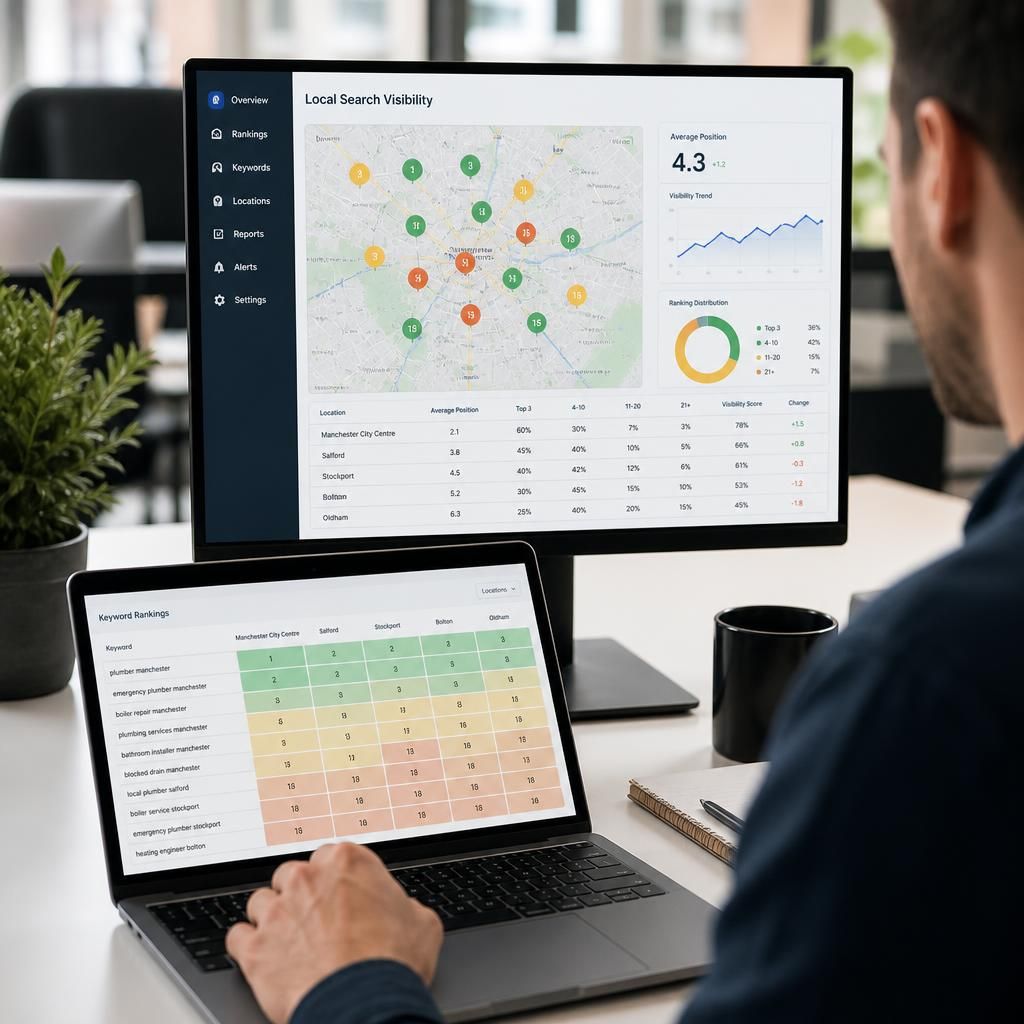
Local search visibility is measured by recording where a business appears for the same keyword from defined locations, rather than assigning it one universal local ranking. This reveals how consistently the business is found across its service area.
A tracking grid or set of fixed locations can show whether visibility is concentrated around the business premises or extends across nearby areas. Results may differ because of proximity, competing businesses, local relevance and the search features displayed in each location. Comparing the same locations over time provides a more dependable view than relying on occasional manual searches.
- Local organic visibility: the position of relevant website pages in standard search results.
- Map visibility: whether the business listing appears, and where it is shown, in map results.
- Geographic consistency: how rankings change between different parts of the town, city or service area.
Review these measures separately before drawing conclusions. Strong organic visibility does not necessarily mean strong map visibility, and a ranking improvement in one area may not represent wider local growth. Tracking both result types across consistent locations makes changes easier to interpret and helps identify where local SEO work is most needed.