
How often should you use a local rank checker?
For most local SEO campaigns, use a local rank checker weekly to identify meaningful changes without overreacting to daily fluctuations. Check more often when launching or changing a campaign, and less frequently—such as monthly—when rankings are stable and no significant work is underway.
For most local SEO campaigns, use a local rank checker weekly. A weekly check is frequent enough to identify meaningful movement while reducing the risk of reacting to short-term fluctuations. Check more often when launching a campaign or making substantial changes, and consider a monthly review when rankings are stable and no significant work is taking place.
Use a more frequent schedule during periods of change. Checking every few days can be useful after updating important landing pages, improving a Google Business Profile, changing local business information, building relevant local links or resolving technical issues. It can also help when a ranking drop requires investigation. Frequent checks in these situations are for diagnosis and monitoring, rather than proof that a change has already produced a lasting result.
Daily checking is usually unnecessary for routine reporting. Local results can vary because of search location, device, language, search history, algorithm changes, competitor activity and changes to the local results displayed for a query. A position that changes from one day to the next may not represent a genuine change in visibility. Looking at a consistent series of checks gives a more reliable view of direction.
Adjust the frequency to the purpose of the campaign:
- New campaign or major SEO work: check more frequently while changes are being implemented and reviewed, then move to a weekly schedule once the campaign settles.
- Established campaign with regular activity: check weekly so that ranking trends can be connected with the work completed during the same period.
- Stable rankings and limited activity: a monthly check may be sufficient for high-level monitoring, provided there are no known issues or important seasonal changes.
- Competitive or high-priority searches: retain at least weekly monitoring, particularly where small changes in local visibility have a material effect on enquiries.
The right schedule also depends on the type of ranking being measured. Local pack positions can be more variable than traditional organic listings, while a business may rank differently across nearby areas. Track the same keywords from the same defined locations, such as selected postcodes, so that changes in rankings are not confused with changes in the search location. Keep device, language and other relevant settings consistent where possible.
Record significant SEO work alongside ranking checks. An annotation can note when a page was revised, a business profile was updated, a citation was corrected or a technical problem was fixed. This makes it easier to distinguish a movement that may be related to your work from one caused by wider search changes or competitor activity.
When reviewing results, focus on trends rather than an isolated position. Examine whether several related keywords have moved, whether visibility has changed across the target area and whether relevant traffic or enquiries show a corresponding pattern. A single keyword moving down does not necessarily indicate a campaign problem, especially if the wider set of tracked terms remains steady.
A practical routine is to run the local rank checker weekly, review the change from the previous check and compare it with a longer-term trend. Escalate to more frequent checks when you are testing a specific change or investigating a sudden movement. Once the cause has been assessed and rankings are stable, return to the normal weekly or monthly schedule. This approach provides useful evidence without allowing normal search-result variation to dictate SEO decisions.
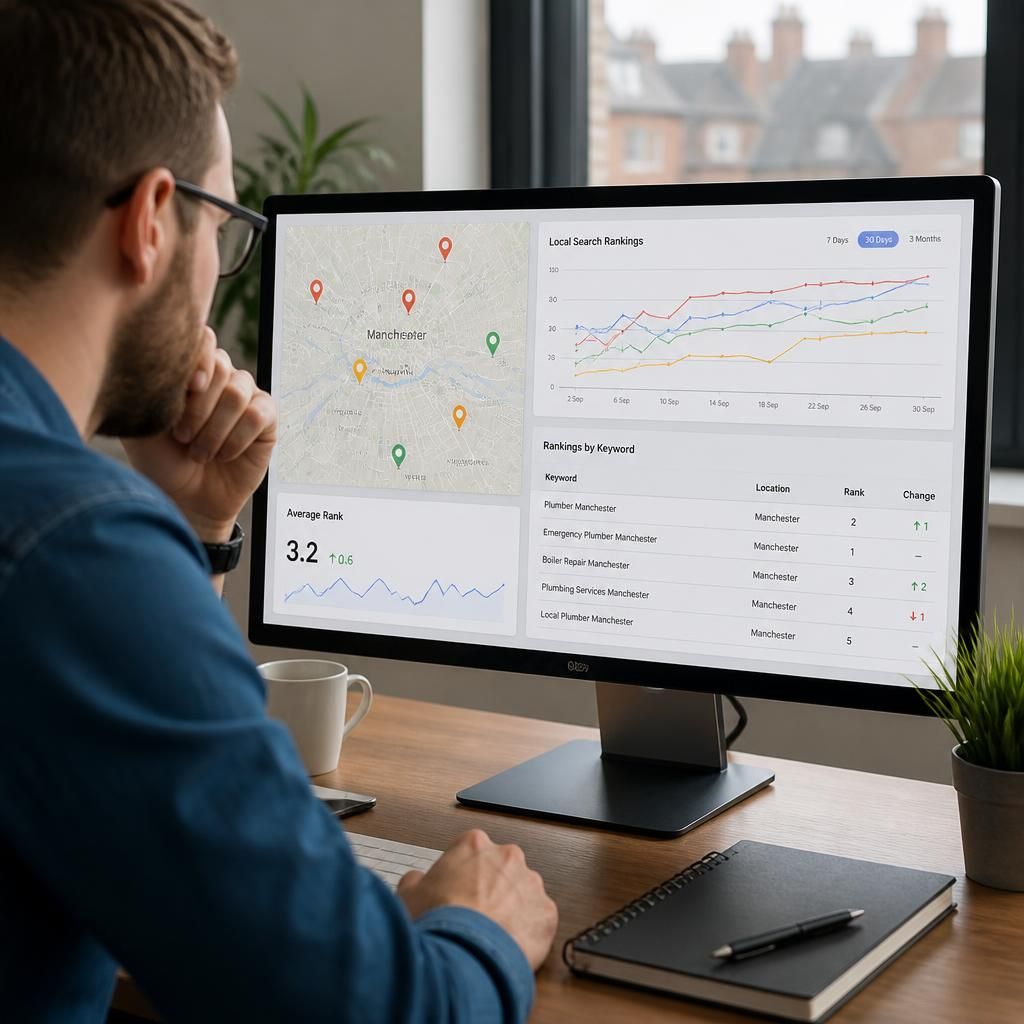
The most reliable way to use a local rank checker is to follow a consistent schedule and compare like-for-like searches. Check rankings weekly for an active local SEO campaign, using the same keywords, postcodes, device settings and language each time. This helps separate genuine changes in visibility from normal variation in local search results.
Record important work alongside each check, such as a landing page update, Google Business Profile change, citation correction or technical fix. If rankings move afterwards, the timing provides useful context, although it does not prove that one change caused the result. Review groups of related keywords and locations rather than relying on a single position.
Use more frequent checks when investigating a sudden drop or assessing a significant change, then return to the normal schedule once the results have stabilised. A monthly review can be suitable for a low-activity campaign with consistently stable rankings, but weekly monitoring is generally more useful where local visibility directly affects enquiries.