
How does a local rank tracker compare rankings across locations?
A local rank tracker compares rankings across locations by checking the same keywords from different geographic points and recording the results for each area. It shows where your business appears in local search, highlights differences in visibility between locations and helps identify areas that need further optimisation.
A local rank tracker compares rankings across locations by running the same keyword searches from defined geographic points and recording the results for each area. It then places the findings side by side, so you can see where a business appears in organic results, the local pack or map results, and where visibility is weaker or absent.
Local search results are not identical for every searcher. Google can adjust results according to the searcher’s location, the searcher’s wording, the business’s relevance to the query, and the strength of competing local listings. A rank tracker controls the location variable as far as possible, making it easier to distinguish broad performance from area-specific differences.
How the comparison works
When setting up a tracking campaign, you select the business, the keywords to monitor and the locations from which those keywords should be checked. Locations may be represented by towns, postcodes, districts, streets or map coordinates, depending on the tracking system. The tracker runs the searches from each selected point, captures the relevant result types and stores the position for that location and date.
For example, the same service keyword might be checked from several districts around a business. The resulting report can show that the business has strong visibility near its premises but appears lower in surrounding districts. It may also show that a location is visible in the local pack but not prominently placed in the organic results, or that it appears organically without gaining a local pack position.
What is compared between locations
- Position: the recorded ranking for the same keyword at each location.
- Result type: whether the business appears in the local pack, map results, organic listings or another tracked search feature.
- Visibility: how prominently the business appears across the tracked results, rather than relying only on one position.
- Coverage: the areas where the business is found and the areas where it is missing or less visible.
- Change over time: whether rankings in a particular area improve, decline or remain broadly stable.
- Competitor presence: which businesses appear in the same local results and whether the competitive landscape varies by area.
A useful comparison keeps the keyword, device type, search language and result settings consistent. If these factors change between checks, the report may reflect more than geographic variation. A sound tracking setup therefore separates location changes from other search conditions wherever the platform allows.
Grid tracking and point-based checks
Many local rank trackers use a grid to compare rankings. Each grid point represents a specific geographic position, and the tracker checks the selected keywords from each point. The results are displayed as a grid, heatmap or location table, allowing you to identify patterns across a service area.
Point-based tracking is useful when you need to monitor particular towns, postcodes or priority areas. Grid tracking provides a broader view and can reveal a gradual decline in visibility as the search location moves away from the business address. Both approaches can be used together: point checks for important markets and a grid for understanding the wider local footprint.
The geographic point is not necessarily the same as the user’s exact location. It is a controlled testing location used to make comparisons more consistent. This distinction matters when interpreting small changes in position. The data is most useful for identifying repeatable patterns rather than treating every individual result as a permanent ranking.
How to interpret differences by area
A stronger ranking in one area does not automatically mean that optimisation is complete there, and a weaker ranking elsewhere does not always indicate a technical problem. Local ranking differences can be influenced by distance from the business, the searcher’s location, the relevance of the landing page, the completeness of local business information, review signals, local links and the number and quality of nearby competitors.
Use the comparison to ask practical questions:
- Is visibility strongest near the business address and weaker in areas further away?
- Are there specific towns or districts where important service keywords underperform?
- Does the business appear for one service but not another in the same location?
- Are local pack results and organic results showing the same pattern?
- Have rankings changed across several checks, or is the difference limited to one observation?
- Do competitors consistently occupy the positions that the business is trying to gain?
A consistent area-based weakness is more actionable than a single low result. It may indicate that the location is not sufficiently relevant to the query, that the website lacks useful local service content, or that local authority signals are weaker in that area. The tracker identifies the pattern; further analysis is needed to establish the cause.
Local pack and organic rankings are different measures
Local rank tracking should distinguish between map or local pack positions and standard organic rankings. The local pack is particularly influenced by proximity, relevance and prominence, while organic rankings are more closely connected with the relevance and quality of the webpage, site structure and wider authority signals. A business can therefore perform differently in these two result types for the same keyword and location.
Comparing both views prevents an incomplete assessment. If organic visibility is strong but local pack visibility is limited, review the business’s local profile, category selection, address consistency and local prominence signals. If the local pack is present but organic visibility is weak, examine the relevant service page, internal linking, content quality and technical accessibility. These are general diagnostic directions rather than automatic explanations for every result.
Using location comparisons to prioritise work
Start by identifying areas that matter commercially, rather than trying to improve every tracked point at once. Compare the rankings for your most important services, then group locations into broad patterns such as strong visibility, inconsistent visibility and limited visibility. Review the underlying search results and relevant landing pages for each group.
Potential actions may include improving a service page’s local relevance, creating genuinely useful content for a priority area, strengthening internal links, correcting business information, improving the business profile or developing relevant local authority. Avoid creating near-identical pages for every postcode or town. Local content should serve a clear user need and provide information that is genuinely specific to the area.
After making changes, continue tracking the same keywords and locations under comparable settings. Look for sustained movement across several checks and consider whether improvements are limited to one area or reflected across the wider service region. This makes the comparison useful for evaluating the effect of SEO work, not just reporting individual positions.
Important limitations
Location-based rankings are estimates of search visibility, not a guarantee that every person in an area will see exactly the same result. Results can vary because of personalisation, device, search history, map settings, language, data refresh timing and changes to the search results page. Local listings can also move as businesses open, close, update their profiles or gain new reviews.
For that reason, do not judge performance from one keyword, one location or one day’s result. Use a consistent set of relevant keywords, track locations that reflect the actual service area and assess trends alongside other evidence such as organic traffic, enquiries, profile actions and conversion data. This gives a more reliable view of whether improvements in local rankings are supporting the wider business objective.
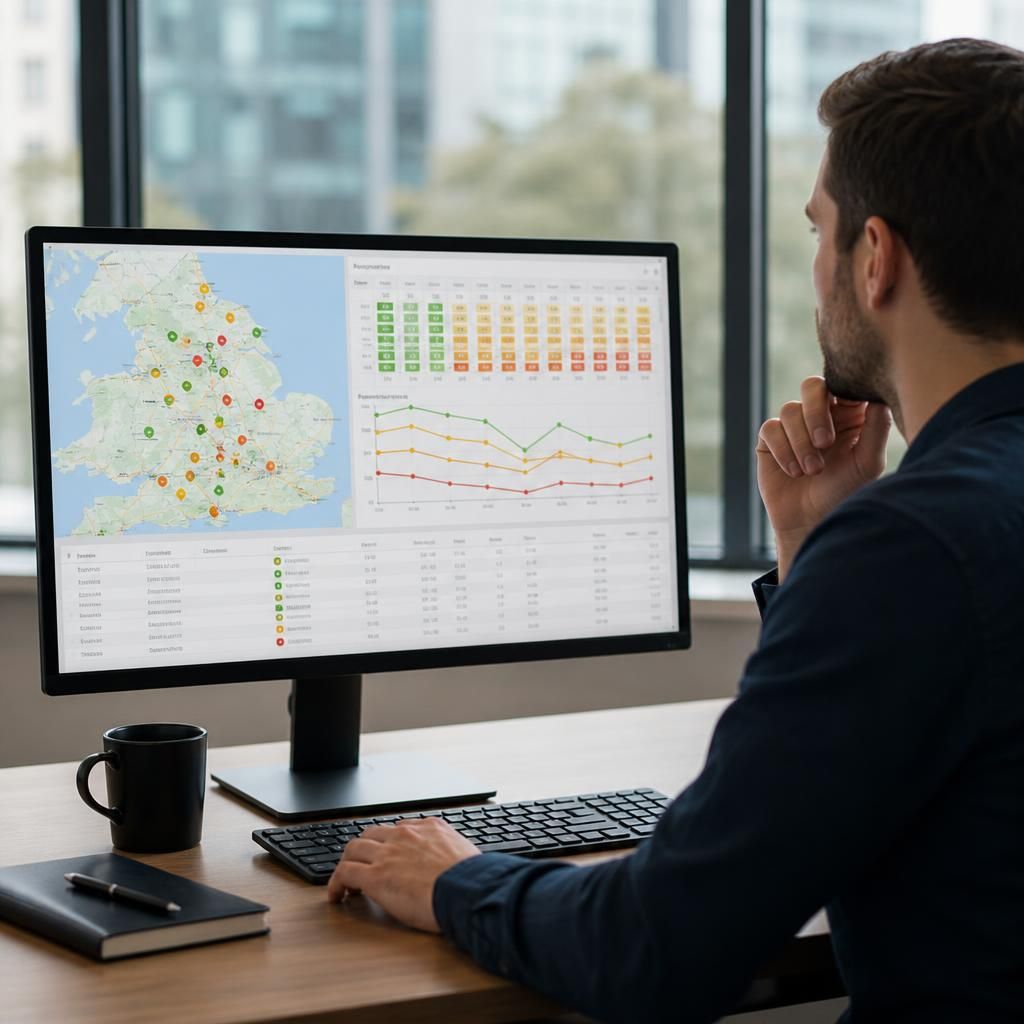
A local rank tracker compares area-based visibility by checking the same keyword from multiple fixed geographic points and recording the result for each one. This creates a consistent view of where your business appears in local pack, map and organic results, rather than relying on a single location near your premises.
Grid tracking makes these differences easier to interpret. Strong visibility around the business address but weaker rankings in surrounding districts may indicate that proximity is influencing local pack results, while a wider organic decline may point to differences in page relevance or local authority. Compare the same keywords, device settings and result types at each point, then review repeated patterns over time rather than treating one result as conclusive.
- Identify areas where important services rank below the level achieved elsewhere.
- Separate local pack performance from standard organic rankings.
- Compare competitor presence across each tracked area.
- Prioritise local content, profile improvements or landing-page work where weaknesses are consistent.