
What is advanced rank tracking software?
Advanced rank tracking software is a platform that monitors a website’s search engine positions for targeted keywords across locations, devices and search features. It goes beyond basic position checks by providing accurate historical data, competitor comparisons, visibility analysis and actionable reporting to support SEO decisions.
Advanced rank tracking software is a platform that monitors a website’s search engine positions for targeted keywords across locations, devices and search features. Unlike a basic rank checker, it combines reliable position data with historical trends, competitor comparisons, visibility analysis, alerts and reporting, helping SEO teams understand not only where a page ranks, but why performance is changing and what action to take.
Search rankings can vary according to the search term, search engine, location, device, language, search history and the type of result being displayed. Advanced software records these conditions consistently so that changes can be assessed against comparable data. This makes it more useful than manually checking search results, where personalised results, local variations and temporary fluctuations can make conclusions unreliable.
What advanced rank tracking software measures
The software begins with a defined keyword set. Keywords may be grouped by topic, product, service, landing page, customer journey stage or location. The platform then checks the selected search results and records the position of the relevant website or page. Depending on the configuration, it can track desktop and mobile results, national and local searches, different search engines, and specific countries, regions, cities or postcodes.
Tracking the ranking URL is important as well as tracking the position. If the page appearing in search results changes unexpectedly, this may indicate keyword cannibalisation, a redirect issue, a technical problem or a change in search intent. Page-level data helps establish whether the intended landing page is performing and whether content is aligned with the query.
Advanced platforms can also identify search features, such as local listings, featured answers, image results, video results, shopping results, sitelinks and other enhanced result types. These features affect how much attention a traditional organic listing receives. A page may retain the same standard ranking while its visibility changes because a search feature has appeared above it, so monitoring the wider results page provides a more complete view of performance.
How it differs from basic rank checking
Basic rank checking usually answers a narrow question: where does a selected keyword rank today? That information can be useful, but it does not explain the wider pattern. Advanced rank tracking software adds context by showing:
- historical position changes over selectable periods;
- ranking performance by device, location, search engine and market;
- the pages receiving impressions for each keyword;
- groups of keywords moving up, down or remaining stable;
- visibility across a complete keyword set rather than isolated terms;
- competitor performance for the same or comparable searches;
- search features appearing for tracked queries;
- alerts for significant gains, losses or technical events; and
- custom reports for different teams, clients or business areas.
This wider view reduces the risk of reacting to a single daily movement. Search positions naturally fluctuate, and an isolated change does not necessarily represent a meaningful performance trend. Looking at groups of related keywords, landing pages and search conditions provides a stronger basis for decisions.
Why historical data matters
Historical rankings allow changes to be compared with work carried out on the website. For example, a movement may follow a content revision, internal linking change, technical release, site migration or improvement to a page’s relevance. Historical records also help distinguish a site-specific change from broader movement affecting many websites in the same search results.
Useful analysis normally compares trends rather than individual snapshots. You can review whether visibility is improving across a topic, whether a particular landing page is gaining traction, or whether rankings have weakened after a change to the site. Annotating important SEO activity in the tracking system makes later analysis easier because ranking movements can be viewed alongside known changes.
Visibility is broader than average position
Average position is only one way to interpret ranking data. It can be distorted when a keyword set contains terms with very different levels of importance or search intent. Visibility measures, share of tracked results and groups based on ranking ranges can provide additional context. For instance, a website may have a strong average position while remaining absent for several commercially important terms, or it may improve its visibility by moving many relevant pages from lower result positions into more competitive positions.
For this reason, advanced analysis should connect ranking data with other SEO indicators, including impressions, clicks, click-through rate, conversions and revenue where those data are available. Rank tracking shows search exposure and position; it does not independently prove that a ranking has generated a business outcome.
Competitor and market analysis
Competitor tracking shows which websites are appearing for the same tracked topics and how their visibility changes over time. This does not require copying another organisation’s approach. It can reveal content gaps, changes in search intent, new areas of competition and search results where your website has an opportunity to improve.
Competitor comparisons are most useful when the tracked websites are relevant to the same market and keyword set. Comparing unrelated domains can produce misleading conclusions. It is also important to assess the quality and intent of the ranking pages, rather than treating every competitor position as an equivalent benchmark.
How teams use the data
Advanced rank tracking software supports several stages of SEO work:
- Planning: organise keywords by business priority, topic, service, product or location and establish a consistent baseline.
- Monitoring: check changes in visibility, landing-page performance and search features without relying on manual searches.
- Diagnosis: identify whether a decline affects one keyword, one page, a topic group, a device type, a location or the wider site.
- Prioritisation: focus effort on pages and queries where improved relevance, technical work or internal linking could have the greatest value.
- Evaluation: compare ranking trends before and after SEO activity while considering other changes in the search landscape.
- Reporting: present concise, consistent information to marketing teams, senior stakeholders and customers using reports suited to their responsibilities.
When investigating a movement, start by checking the date range and tracking configuration. Confirm that the keyword, search engine, device and location have not changed. Then review the ranking URL, search features, landing-page changes and wider visibility trend. Search performance data should be considered alongside crawl data, analytics, conversion information and the page itself before a corrective action is selected.
Accuracy and configuration
The value of a tracking platform depends on how consistently it collects and presents data. A useful setup should use clearly defined locations, devices, search engines, keyword groups and update schedules. Keywords should reflect the language used by the intended audience and should be reviewed when products, services, markets or search behaviour change.
Local tracking requires particular care. A ranking for a broad country is not the same as a ranking from a specific town or service area. Where local visibility matters, track locations that reflect the areas served and interpret results in the context of local listings, proximity and search intent.
No rank tracking tool can guarantee that every user will see exactly the same results. Search engines personalise and adapt results, and rankings can change between checks. The purpose of a well-configured system is to provide a consistent, comparable view of performance rather than to reproduce every individual search result.
What advanced rank tracking software does not do
Rank tracking does not replace technical SEO auditing, content review, link analysis, analytics or conversion measurement. It identifies changes in search visibility, but it cannot by itself explain every cause. A ranking decline could relate to page quality, technical accessibility, changing search intent, competitor improvements, algorithmic changes, seasonality or a temporary results-page change.
It also does not make a keyword strategically valuable simply because it has a high position. A relevant lower-volume term that attracts qualified visitors may be more useful than a broad term that produces little engagement. Keyword selection and interpretation should therefore remain connected to business objectives, audience needs and the performance of the pages receiving organic traffic.
In practice, advanced rank tracking software is most effective when it becomes a reliable measurement layer within the wider SEO process. Use it to establish a baseline, monitor meaningful trends, investigate changes, compare visibility across important markets and communicate progress. Combine its findings with search analytics and page-level analysis to turn ranking data into informed, practical SEO decisions.
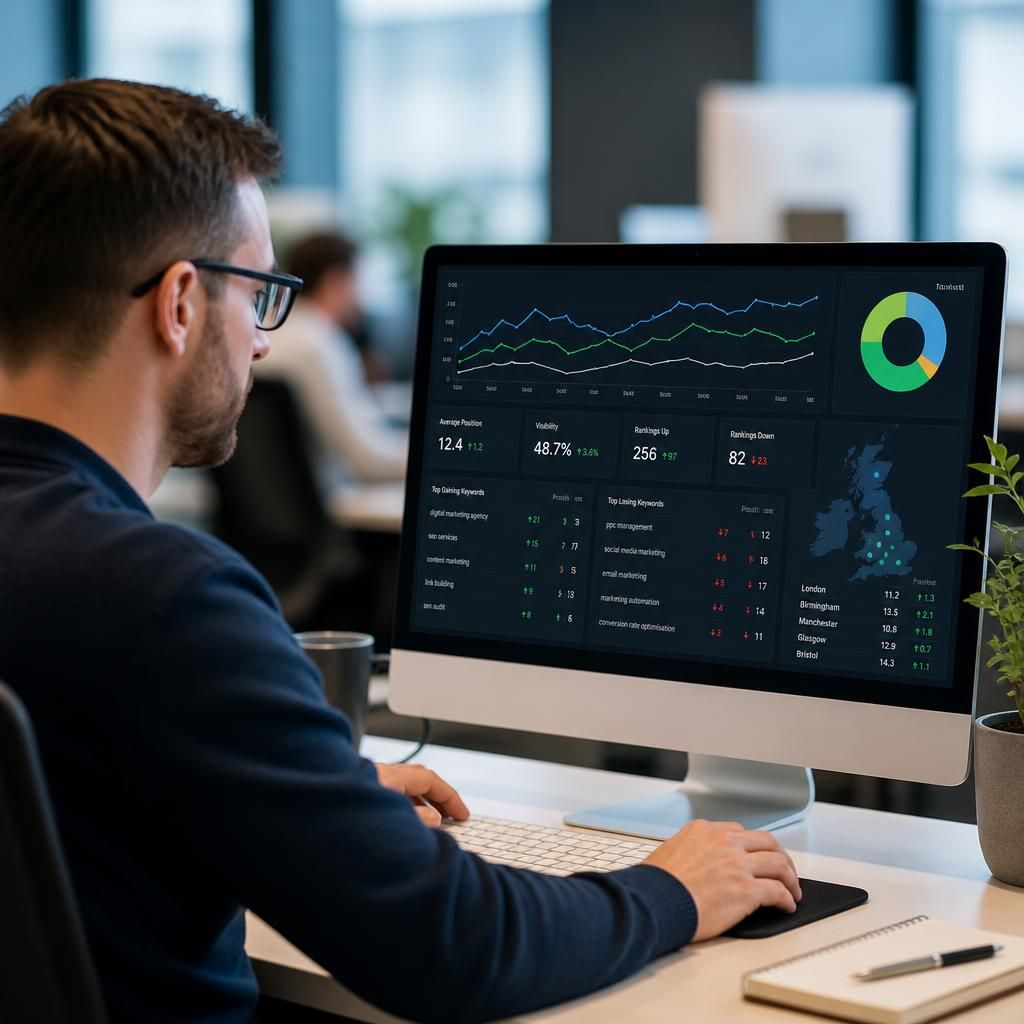
Advanced rank tracking software measures search visibility under consistent conditions, such as the same keyword, location, device and search engine. This makes ranking data more reliable than manually checking results, which can vary because of personalisation, local intent and changing search features.
For useful analysis, configure tracking around the markets and pages that matter to your business. Group keywords by topic, service, product or landing page, then review position trends alongside the ranking URL and wider visibility. If a page changes unexpectedly, this may indicate keyword cannibalisation, a technical issue or a shift in search intent.
Historical data also helps you compare ranking movements with SEO activity, including content updates, internal-linking changes and technical releases. Use these comparisons to identify meaningful trends rather than reacting to isolated daily fluctuations.