
What does a specialist local SEO tool do?
A specialist local SEO tool helps you improve and manage visibility in location-based search results by monitoring local rankings, analysing competitors, managing business listings and identifying optimisation opportunities. It brings these activities together so you can measure performance across locations and focus on attracting more relevant local enquiries.
A specialist local SEO tool helps you improve, monitor and manage visibility in location-based search results. It brings local rank tracking, business listing management, competitor analysis, review monitoring, location data and reporting into one workflow, allowing you to identify where a business is appearing, where it is losing visibility and which actions are most likely to generate relevant local enquiries.
Local search performance is influenced by several connected factors rather than a single ranking position. A tool designed specifically for local SEO helps you assess these factors at individual locations, service areas and branches. This is important because local results can vary significantly between nearby towns, postcodes and searchers, even when they use similar wording.
Monitoring local rankings and visibility
A specialist tool tracks how a business appears for selected local search terms across defined locations. Instead of relying on a single manual search, it can show visibility patterns across towns, postcodes, offices or service areas. Depending on the platform, this may include traditional organic results, local pack positions, map results and other prominent search features.
This allows you to:
- Compare performance between target locations.
- Identify search terms where visibility is improving or declining.
- Separate brand searches from non-brand service searches.
- See whether a branch or service area is being discovered for the right terms.
- Measure the effect of local content, listing changes and technical improvements.
Local rank tracking is most useful when it is interpreted alongside impressions, clicks, enquiries and conversion data. A ranking change does not automatically represent a change in business value, particularly where search intent varies between locations.
Managing business listings and location information
Search engines and local directories use business information to understand where a company operates and what it provides. A local SEO tool can help you audit and manage this information across relevant business listings, including business name, address, telephone number, website, opening hours, categories and services.
Centralised listing management helps reduce inconsistent or outdated information. It can also make it easier to identify duplicate listings, missing profiles, incorrect opening hours and location records that need review. Consistency does not guarantee higher rankings, but inaccurate information can create confusion for both search engines and potential customers.
For organisations with several branches, the tool should support location-level workflows. This may include assigning access, reviewing changes, maintaining separate business details and producing reports for each branch without losing an overall view of the campaign.
Analysing local competitors
Local competitor analysis shows which businesses are visible for the same services and locations. A specialist tool can compare ranking coverage, listing completeness, review activity, local landing pages, categories and other observable signals. The purpose is not to copy another business, but to identify gaps in your own local search strategy.
For example, analysis may reveal that competing businesses:
- Appear for service searches that are not covered by your location pages.
- Have more complete business profiles or a wider range of relevant categories.
- Receive more recent customer reviews for a particular branch.
- Have developed stronger local relevance through useful, location-specific content.
- Are visible in areas where your business has little or no ranking coverage.
Competitor data should be treated as evidence for investigation rather than a complete explanation of performance. Tools can show what is visible, but they cannot always establish why a search engine has chosen one result over another.
Finding local optimisation opportunities
A local SEO tool can bring together audits and recommendations relating to local landing pages, business listings, technical accessibility, structured data, internal links and on-page relevance. It may flag missing location information, inconsistent contact details, weak page titles, duplicate content, unavailable pages or insufficient detail about local services.
The most useful recommendations are prioritised by likely impact and practical importance. A business should generally address fundamental problems first, such as incorrect location details, inaccessible pages or poorly configured listings, before spending time on minor wording changes. Recommendations also need human review because a technically valid change can still be unhelpful if it makes a page less clear for customers.
Supporting reviews and local reputation activity
Reviews provide useful evidence about customer experience and can influence how people assess a local business. Some local SEO tools monitor review activity across supported platforms, helping you identify new reviews, unanswered feedback, recurring themes and potential service issues.
This function is primarily operational rather than purely promotional. Prompt, accurate and professional responses can clarify information and demonstrate that feedback is being considered. A tool should not be used to produce identical or misleading replies at scale. Review requests must also follow the relevant platform rules and applicable privacy and consumer protection requirements.
Connecting local SEO activity with enquiries
Visibility is only one part of local search performance. A well-configured tool can help connect ranking and listing data with website visits, calls, form submissions, directions requests or other agreed conversion actions. This makes it easier to distinguish increased exposure from genuinely useful traffic.
Tracking should reflect how customers actually contact the business. For some organisations, a completed enquiry form is the main outcome. For others, telephone calls, bookings, visits to a branch or requests for directions may be more relevant. Where possible, local SEO reporting should combine platform data with analytics and customer relationship management records so that lead quality can be assessed as well as lead volume.
Providing campaign reporting
Reporting turns local SEO data into an explanation of progress and next actions. A specialist tool can provide dashboards or scheduled reports covering visibility, rankings, listings, reviews, technical issues, competitor movement and conversions. Reports can usually be filtered by location, service, device, campaign or time period.
A useful report should answer practical questions:
- Which locations are gaining or losing visibility?
- Which services are attracting local search demand?
- Are business details accurate and consistent?
- Which issues require action first?
- Are improvements producing relevant visits or enquiries?
- What should be tested or completed during the next reporting period?
Reports are more reliable when tracking settings remain consistent. Changes to search terms, locations, devices, competitors or measurement methods can make comparisons misleading. Record significant changes so that performance trends are interpreted in context.
How a local SEO tool fits into the wider process
The tool does not replace local SEO judgement or implementation. It collects evidence, highlights issues and reduces repetitive work, while decisions still require an understanding of the business, its customers, service areas and competitive environment. The typical process is to audit existing visibility, correct inaccurate information, improve relevant pages and listings, monitor movement, review conversions and refine the work based on evidence.
When selecting or using a specialist local SEO tool, prioritise accurate location tracking, dependable data, clear task management, suitable integrations, branch-level controls and reporting that can be understood by both specialists and stakeholders. Avoid treating a single score as a complete measure of success. Local SEO performance is better assessed through a combination of visibility, search relevance, customer actions and the quality of resulting enquiries.
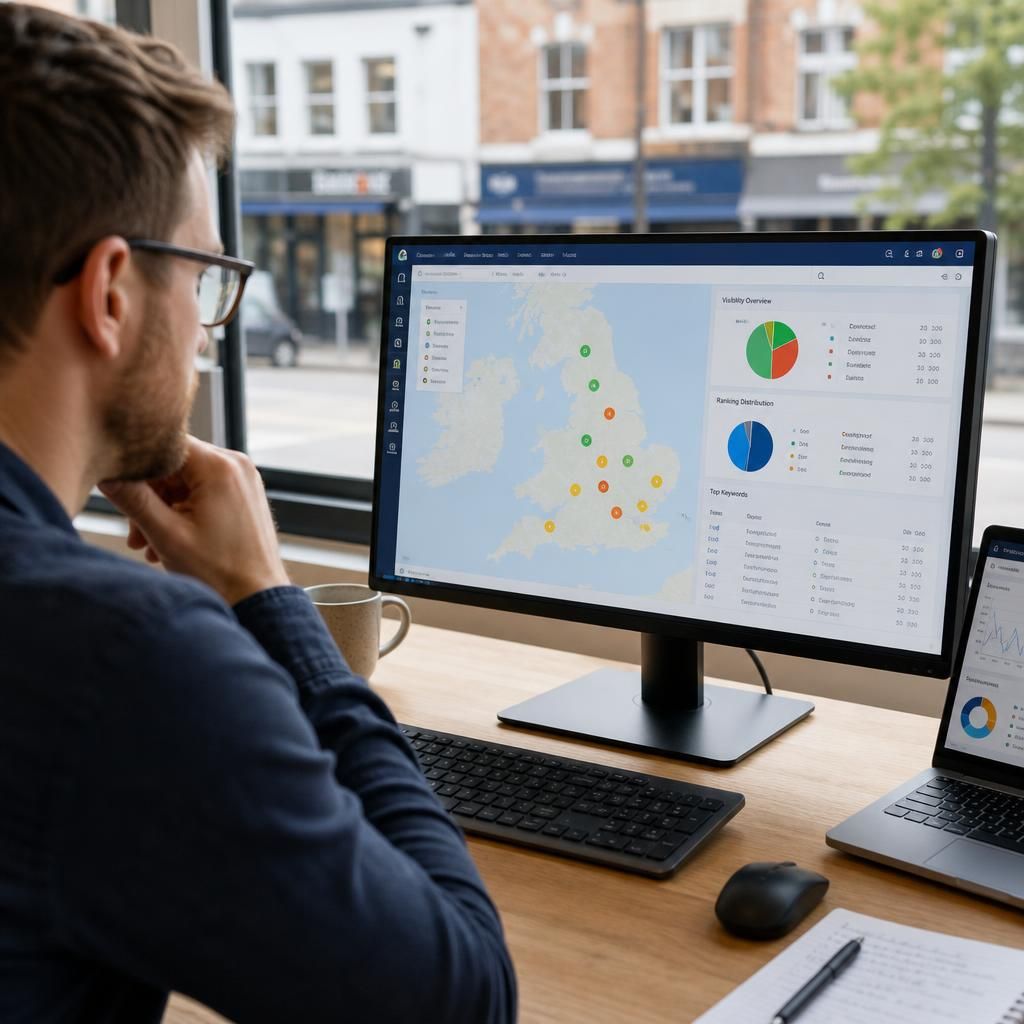
A specialist local SEO tool brings location-specific search data into one place, showing how a business appears for relevant services in each town, postcode or service area. It combines local rank tracking with listing checks, competitor visibility and conversion data so you can identify which locations need attention and whether improvements are generating useful enquiries.
This is particularly valuable for businesses with multiple branches or broad service areas. A single overall ranking can hide important differences between locations, while a local SEO tool helps you review branch details, monitor map and organic visibility, and prioritise actions such as correcting business information or improving a location page.
- Compare visibility across locations and services.
- Identify inaccurate, missing or duplicate business listings.
- Connect local search activity with calls, forms, bookings or other enquiries.